
BURGENLAND
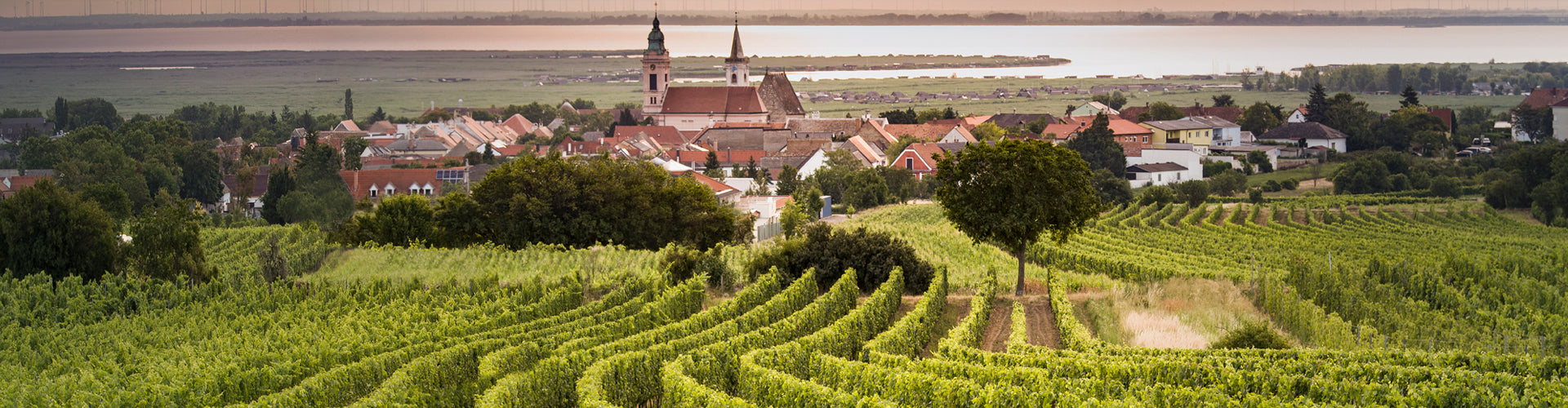
The easternmost state of Austria, Burgenland, is governed by the hot, continental Pannonian climate that drifts in from the Hungarian plains. This warmth provides the perfect environment for producing the country’s most authoritative and structured red wines, while the region’s unique local humidity simultaneously fosters the development of legendary sweet styles. The landscape is a diverse mosaic of terroirs, each lending a distinct voice to the wines produced there. In the southern Eisenberg area, the unique soils combine with cooler influences to produce Blaufränkisch wines of incomparable elegance and fine minerality. Moving towards the heavy loam soils of Mittelburgenland, these same red grapes take on a deeper, more powerful character with incredible length on the palate.
The influence of the landscape is equally clear when looking at the region’s white wine production. To the east of Lake Neusiedl, the unique soils of the Leitha Range—composed of limestone and slate—create a sophisticated terroir that supports complex white varieties like Pinot Blanc, Chardonnay, and Grüner Veltliner. Meanwhile, the areas surrounding the lake itself are defined by a singular microclimate. To the south, the Seewinkel region features a high density of small, shallow lakes known locally as "Zicklacken." These create a humid environment that consistently encourages the onset of Noble Rot, allowing growers to produce world-class sweet wines like Beerenauslese and Trockenbeerenauslese as a matter of routine rather than exception.
This region is also home to one of the most famous sweet wines on the planet, Ruster Ausbruch, which remains a cornerstone of the local viticultural identity. Beyond these historic sweet traditions, Burgenland has seen a modern revolution driven by a pioneering generation of winegrowers. These producers have moved aggressively to elevate the region’s reputation, mastering the art of the powerful red cuvée blend and successfully championing international grape varieties alongside native staples like the juicy, fruit-forward Blauer Zweigelt. It is this combination of deep historical prestige and modern, open-minded innovation that has made Burgenland one of the most exciting and authoritative wine regions in all of Europe.
THE LINE UP

Heidi Schröck & Söhne `Junge Löwen` 2023
- Regular Price
- £18.00
- Offer Price
- £18.00
- Regular Price
-
- Unit Price
- /
A fresh & juicy red wine with smooth tannins and an elegant finish...
Read More...

Heidi Schröck & Söhne 'Rusterberg' Zweigelt 2024
- Regular Price
- £21.00
- Offer Price
- £21.00
- Regular Price
-
- Unit Price
- /
A juicy red wine with great finesse, aromas of raspberry & cocoa and silky tannins...
Read More...

Heidi Schröck & Söhne Furmint 2024
- Regular Price
- £22.50
- Offer Price
- £22.50
- Regular Price
-
- Unit Price
- /
A uniquely aromatic & textural dry Furmint, aged on its lees in large acacia casks...
Read More...

Michael Opitz 'Buddy Talk' Red 2022
- Regular Price
- £16.00
- Offer Price
- £16.00
- Regular Price
-
- Unit Price
- /
The grapes in this juicy red go together well, just like real buddies...
Read More...

Michael Opitz 'Simply Pure' Blaufränkisch 2021
- Regular Price
- £17.00
- Offer Price
- £17.00
- Regular Price
-
- Unit Price
- /
Pure, fruity & uncomplicated red for lovers of the typical cool spice Blaufränkisch offers...
Read More...